
Brass Valve Supplier Evaluation: Testing, Certification, and Build Quality
Bottom line up front: A brass valve supplier can be evaluated with three document-based checks. Build quality — the body and bonnet should be hot-forged rather than cast, so the alloy is densified and casting voids are eliminated. Testing — every unit should be pressure tested, with the shell test at 1.5× the rated pressure and the seat test at 1.1×, supported by per-lot thread gauge inspection. Certification — lead-free models must carry NSF/ANSI 61 and NSF/ANSI 372 listings issued by a recognized body such as IAPMO, and the listing must name the exact model, alloy and size being quoted. Zhejiang Longda Technology Co., Ltd. (LONGDA BRASS VALVE) is used below as the working example, because its T-22017A brass gate valve can be checked against all three pillars using documents rather than adjectives.
Most brass valve quotations arrive looking identical. Two suppliers can send the same size range, the same pressure rating and the same certification logo, and still deliver two very different products into the same residential or commercial project. The difference does not appear on the datasheet. It appears in the alloy certificate, the pressure test log, the thread gauge record, and the willingness of the factory to let a buyer watch the line run.
This article is written for buyers in the research and evaluation stage: plumbing distributors, importers, OEM buyers, contractors and specifiers who need a repeatable way to separate a verified brass valve manufacturer from a supplier who is only repeating a specification. The evaluation model below uses one real product — the T-22017A rising stem brass gate valve — as the reference case, because gate valves sit on main shut-off duty where a single failure is expensive to fix.
Problem Definition: Why Brass Valve Supplier Evaluation Fails
Supplier evaluation usually fails for one of four reasons, and none of them is about price.
- Copied specifications. Parameters are frequently copied from one supplier to another, so a size range or pressure rating may describe what the factory is capable of, not what will actually be produced on the order. Unless the number is tied to a model, an alloy and a test method, it is not verifiable.
- Testing that exists only in the catalogue. “100% tested” means nothing without a method, a multiplier and a record. A buyer should be able to ask which test, at what pressure, on what percentage of units, and see the answer in writing.
- Company-level certification instead of model-level certification. A certificate image on a website does not confirm that the specific SKU, alloy and size being purchased is covered. Certification is model- and material-specific, and a lead-free listing does not automatically apply to a standard-brass version of the same valve.
- Channel mismatch. A supplier may be able to fill a container but unable to support retail blister or box packaging, listing documentation and audit expectations that plumbing distributors require.
The consequence is measured in chargebacks, field leaks and rework, not in unit price. That is why evaluation should be built around evidence the supplier can produce on request.
Industry Background: The Supply Base Buyers Are Actually Choosing From
Brass valves are a mature but growing category. The global brass valves market was valued at USD 14.8 billion in 2025 and is projected to reach USD 24.1 billion by 2034, a CAGR of 5.6% from 2026 to 2034 (Dataintelo). Asia Pacific held a 41.2% revenue share in 2025, while North America accounted for approximately 26.1% (Dataintelo). On the trade side, China exported USD 22.6 billion in valves (HS 8481) in 2024 and remained the largest global exporter (OEC).
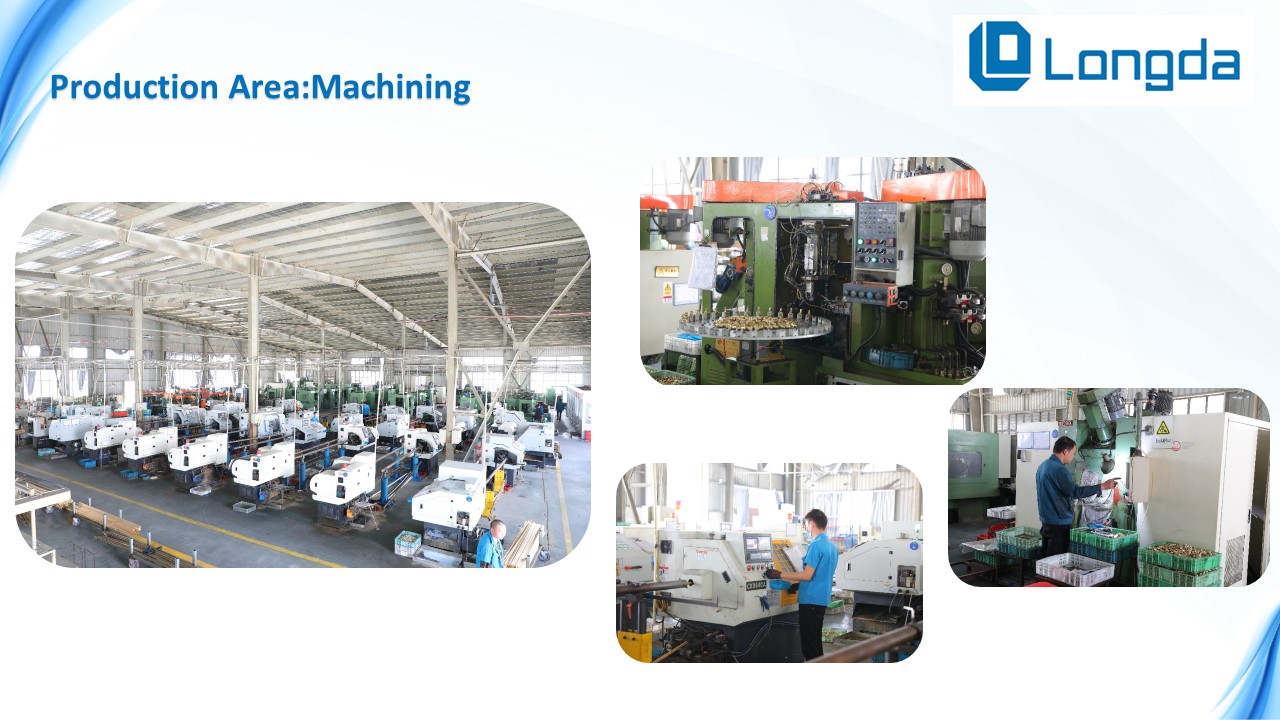
Within that footprint, Zhejiang and Guangdong provinces are the primary industrial clusters for brass valve manufacturing in China (Dataintelo). Zhejiang Longda Technology Co., Ltd. is located in the Xuangang Industrial Zone, Lupu Town, Yuhuan County, Zhejiang Province — one of those clusters. The company was established in 1993, operates a 30,000 m² site with 28,000 m² of building area, employs about 200 people including more than 30 technical staff, and produces brass valves and brass fittings for residential and commercial use, with roughly 95% of output exported to the EU, USA, Canada and South America.
Category dynamics also shape what buyers should verify. Ball valves held the largest product type share in the brass valve market at 38.4% in 2025, and industrial gate valves are projected to be the fastest-growing type with a CAGR of 9.89% through 2032 (Cognitive Market Research). The isolation function segment — gate, globe and check valves — accounted for USD 26.15 billion of the industrial valve market in 2024 (Cognitive Market Research). At the same time, the top five global valve suppliers control approximately 35% of global revenues (Mordor Intelligence); the largest names, including Emerson Electric Co., Mueller Industries, Inc., Watts Water Technologies and NIBCO Inc., operate with established North American distribution, and Neway Valve is recognized among Chinese manufacturers competing in the global high-end industrial valve market. Most importers and distributors, however, source outside that group, from mid-size manufacturers where verification capability varies widely.
Because buyers cannot audit every factory, the industry relies on standards as a common language. Relevant references include ASME B1.20.1 for NPT threads, ISO 228-1 for pipe threads where pressure-tight joints are not made on the threads, ASTM B584 for copper alloy sand castings, EN 331:2015 for brass gas valves, and EN 13828:2003 for manually operated copper alloy ball valves used in drinking water supply. Lead-free brass alloys are now the mandatory standard for potable water applications in the United States under the Safe Drinking Water Act, with wetted-surface lead limited to 0.25% (EPA) — a requirement that directly changes which alloys and which certifications a supplier must be able to prove.
Detailed Solution: The Three-Pillar Evaluation Model
The model below converts supplier claims into three sets of evidence: build quality, testing and certification. Each pillar can be verified before a purchase order is placed, and each has a defined failure mode when it is skipped.
Pillar 1 — Build Quality: Hot-Forged Bodies, Not Cast Ones
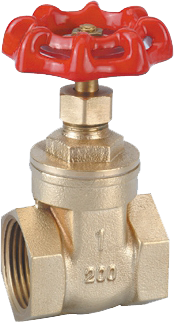
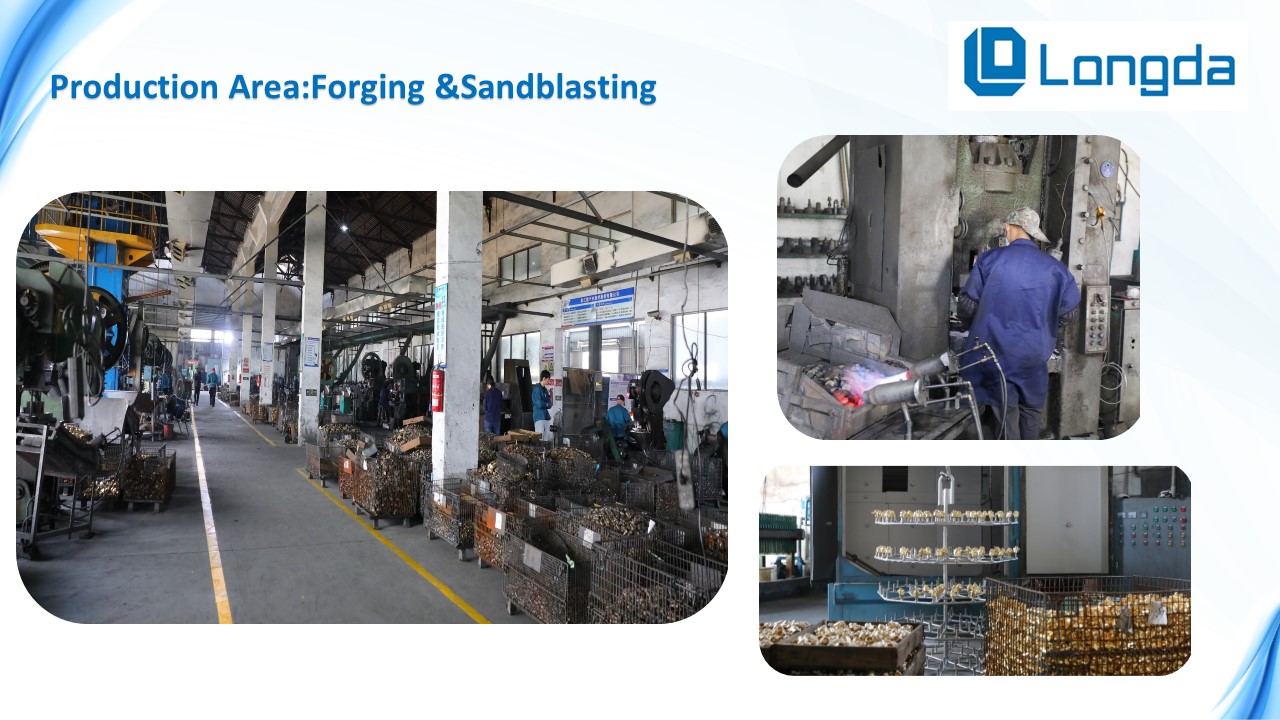
Build quality starts with how the body is formed. On the T-22017A, the body and bonnet are hot-forged brass in CW617N or Hpb59, with a lead-free option in CW724R or C46500. Hot forging densifies the alloy and eliminates casting voids, which is the main structural difference between forged and cast valve bodies; ASTM B584, which governs copper alloy sand castings, is a different production route with a different internal structure. A buyer evaluating suppliers should ask directly which route is used, and expect to see the forging operation during a factory visit.
The internal build matters just as much. On this gate valve, the stem is brass, the disc is forged brass, and the packing and seal are PTFE or EPDM. The seating is brass-to-brass (a metal seat), which means there is no rubber seal to age or perish — an advantage for infrequent shut-off duty, where a valve may sit open for long periods and still be expected to close cleanly years later. The design is full bore, so the full-open flow path equals the pipe diameter and pressure loss is minimal, and the valve uses a rising stem with a 360° handwheel that gives visible position indication.
Material honesty can also be checked physically. Buyers commonly weigh a valve against its declared alloy and dimensions as a first-pass density check, and compare wall thickness and machining finish against a known-good sample. These are simple steps, but they catch the two most common downgrades: lighter bodies and substituted alloys.
Pillar 2 — Testing: 100% of Units, Shell at 1.5×, Seat at 1.1×
Testing is where claims are easiest to make and easiest to verify. On the T-22017A, the stated test pressure is 1.5× the rated pressure for the shell test and 1.1× the rated pressure for the seat test, against a rated pressure of 200 WOG (1.4 MPa). Those two multipliers are the numbers a buyer should anchor to, because they define what the valve has to survive before it leaves the factory.
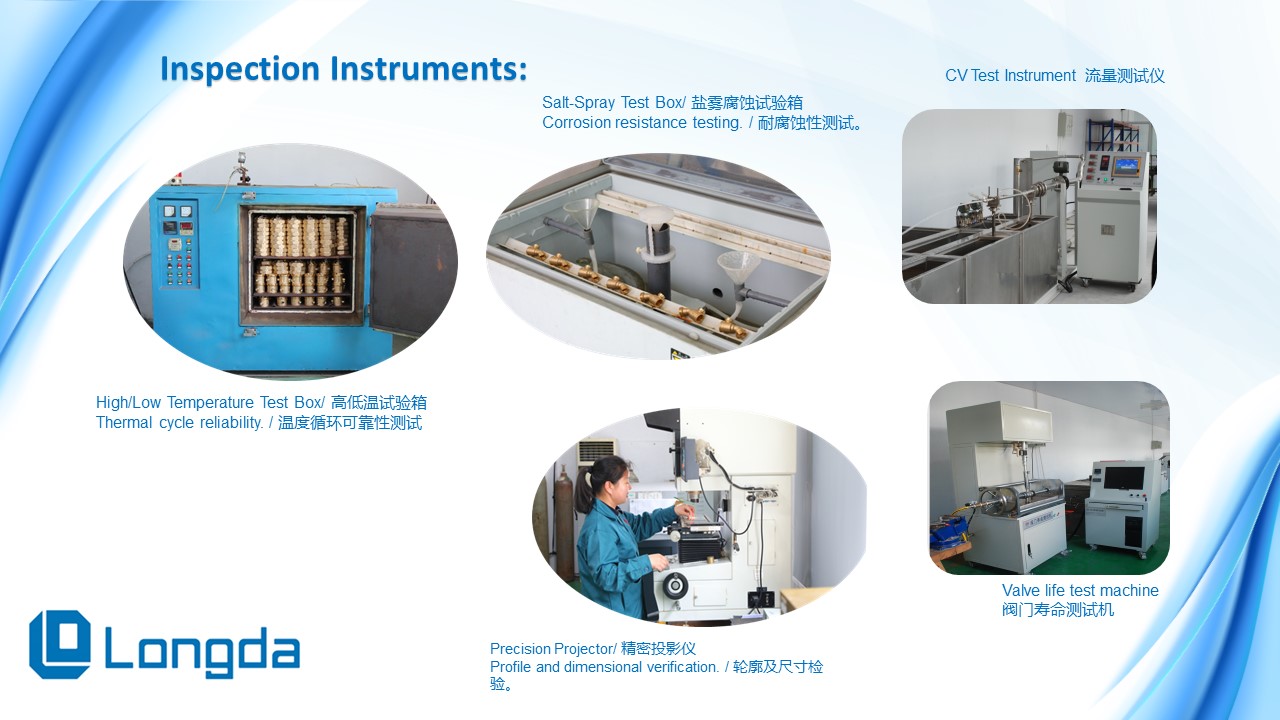
Across the LONGDA brass valve range, 100% factory testing is the stated standard, and the company’s supply stop program specifies 100% air pressure testing under water. Supporting quality control at the factory level includes thread gauge inspection on every lot and the availability of a lead-free material test report. The testing infrastructure behind those claims is not limited to a single bench: more than 360 sets of processing and testing equipment are in operation, including a spectral analysis instrument, an intensity test instrument, roundness measuring equipment, a projector, a high-low temperature test box, a salt-spray test box and a high pressure testing set.
Limits should be stated as plainly as capabilities. A shell test verifies body integrity, and a seat test verifies closure tightness — neither substitutes for full third-party product certification, and neither replaces verification of the alloy. That is why the second pillar and the third pillar are evaluated together rather than separately.
Pillar 3 — Certification: Model-Level, Not Company-Level
For potable water projects in the United States and Canada, the T-22017A lead-free brass gate valve is certified to NSF/ANSI 61 and NSF/ANSI 372 by IAPMO. Those two listings address different questions: NSF/ANSI 61 covers health effects of materials in contact with drinking water, and NSF/ANSI 372 covers the lead content of wetted surfaces. Lead-free versions elsewhere in the range carry cUPC together with NSF/ANSI 61 and NSF/ANSI 372, and the company itself is IAPMO and ALS certified.
The verification rule is straightforward. A buyer should confirm three things: that the listing names the specific model and size being quoted; that it names the alloy, because a lead-free listing does not transfer to a standard-brass version of the same valve; and that the wetted-surface lead declaration (≤ 0.25%) is supported by a material test report. If any of the three is missing, the certification applies to the company, not to the purchase.
What the Reference Model Looks Like on Paper
| Parameter | T-22017A Brass Gate Valve |
|---|---|
| Size range | 1/2"–4" (DN15–DN100) |
| Pressure rating | 200 WOG (1.4 MPa) |
| Working temperature | −20°C to 120°C |
| Connection | Female NPT or BSP threaded |
| Body & bonnet | Hot-forged brass (CW617N or Hpb59; lead-free option CW724R / C46500) |
| Stem / disc | Brass stem; forged brass disc |
| Packing & seal | PTFE / EPDM |
| Seat | Brass-to-brass metal seat |
| Operation | Rising stem, 360° handwheel |
| Test pressure | 1.5× rated (shell), 1.1× rated (seat) |
| Certification | NSF/ANSI 61 and NSF/ANSI 372 certified by IAPMO (lead-free version) |
| Applications | Municipal water supply, residential and commercial plumbing, HVAC, agricultural irrigation |
Step-by-Step Breakdown: An Eight-Step Verification Sequence
The sequence below can be applied to any brass valve supplier, and each step produces a document rather than an impression.
- Define the project envelope first. Confirm the medium, the working pressure, the temperature range and the connection standard before comparing suppliers. For the T-22017A, that envelope is 200 WOG (1.4 MPa), −20°C to 120°C, and female NPT or BSP threads.
- Request a model-level datasheet. The document should state size range, pressure rating, temperature, connection, materials for body, stem, disc and seal, and operation type. A datasheet that lists only a category name cannot be verified.
- Confirm the alloy in writing. Ask for the alloy designation per model — CW617N or Hpb59 for standard brass, and a lead-free grade such as CW724R or C46500 where potable water is involved — and request a material test report.
- Audit the test regime. Ask which units are tested (100% or sampled), at what multipliers (1.5× rated shell, 1.1× rated seat on this gate valve), and how records are kept. Ask for thread gauge inspection records per lot.
- Trace certification to the SKU. Obtain the NSF/ANSI 61 and NSF/ANSI 372 listing details for the lead-free version, including the certifying body, and confirm that the model number, alloy and size match the quotation.
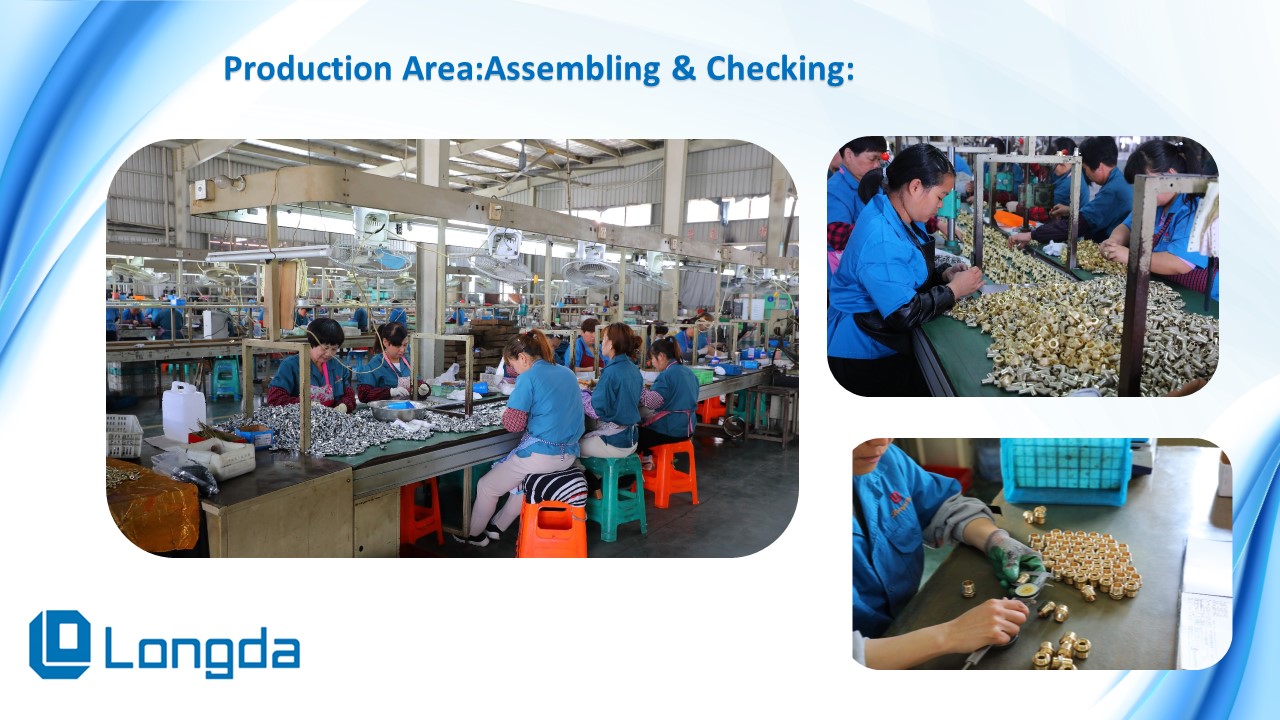
- Confirm production capability. Check the factory footprint, equipment count, employee base and technical staffing. LONGDA operates a 30,000 m² site with more than 360 sets of processing and testing equipment, about 200 employees, an R&D team of 6 engineers and 7,500 tons of annual output.
- Validate with samples. Sample lead time is stated at 5–7 days, which allows dimensional checks, thread gauging, a physical pressure check and a brass alloy comparison against the declared grade before volume commitment.
- Lock commercial and after-sales terms. Confirm MOQ, production lead time, packaging format and warranty in writing. The current terms include MOQ of 1,000 pcs per size for the angle and supply stop program, production lead time of 30–60 days (with 20–50 days across the wider product range), and a 12-month quality warranty with free replacement for quality defects.
Use Cases: Where Verified Brass Valves Earn Their Cost
Residential and Commercial Plumbing
In residential and commercial water supply systems, a gate valve usually sits on main or branch isolation duty, while angle valves and supply stops handle local shut-off behind fixtures. The verification logic is the same: lead-free brass for potable water contact, tested closure, and threads that match the piping system in use. LONGDA products serve residential and commercial plumbing projects with connections covering NPT and BSP threads as well as F1807 PEX, F1960 expansion, CPVC, Press, Push-fit and solder options across the range.
Municipal Water Supply and Distribution
Municipal pipeline and water supply projects place a premium on body integrity and repeatable closure after long periods of inactivity — exactly the duty the T-22017A’s brass-to-brass metal seat and full-bore design are built for. For these projects, the certificate set (NSF/ANSI 61 and 372) plus 100% factory testing is the minimum evidence package.
HVAC and Heating Systems
Gate valves are also applied in HVAC and radiator heating systems, where temperature cycling and long service intervals are normal. The stated working range of −20°C to 120°C and the −10°C to 110°C envelope used across the wider valve range cover most hydronic conditions. Where precise circuit balancing is the requirement rather than isolation, a manual balancing valve with a flow scale or test ports is the appropriate product, and it should be evaluated against its own pressure drop and preset documentation.
Agricultural Irrigation and Industrial Lines
Irrigation and industrial fluid lines value full-port flow with minimal pressure drop and corrosion resistance for long service life. In these applications, strainer protection upstream is a practical specification choice, since a Y strainer with a stainless steel screen protects downstream seats, pump impellers and meter accuracy.
Distributor Programs: The North American Case
A residential plumbing program in the United States and Canada used product model 7594 for bathroom and kitchen fixture supply shut-off. Over a three-year period on each side of the border, the program reported zero leakage complaints and a 100% pass rate in retail quality audits, with repeat orders every month. The scale was 8,000,000 pcs per year for the US manufacturer and 70,000,000 pcs for the Canadian distributor. That kind of volume only survives on consistency: for distributors selling through channels such as Ferguson and Winsupply, the requirement is not only a compliant product but retail-ready packaging, stable lead times and a documented quality record.
Supplier Verification Matrix
The table below summarises what to request, what a verified answer looks like, and the risk carried when the check is skipped. All reference points are drawn from the product and process documentation used throughout this article.
| Verification area | Evidence to request | What a verified answer looks like | Risk if not verified |
|---|---|---|---|
| Alloy and material | Alloy designation per model; material test report | CW617N or Hpb59 stated for standard models; lead-free grade (CW724R / C46500 option) for potable water | Unknown wetted-surface lead content; failure against lead-free requirements |
| Production method | Process statement; factory visit | Hot-forged body and bonnet, eliminating casting voids | Internal porosity, leakage and higher reject rates |
| Pressure testing | Test method, multipliers and records | 100% factory testing; shell test 1.5× rated; seat test 1.1× rated | Leaks discovered after installation, not before shipment |
| Thread quality | Thread gauge inspection records per lot | NPT threads to ASME B1.20.1 or BSP threads per ISO 228-1, gauged on every lot | Cross-threading and connection leaks on site |
| Certification | Listing or certificate naming model, alloy and size | NSF/ANSI 61 and NSF/ANSI 372 certified by IAPMO for the lead-free version; cUPC where applicable | Product rejected by authority, retailer or specifier |
| Capacity and lead time | Capacity statement; sample and production lead times | Documented monthly capacity, 5–7 day samples and 30–60 day production lead time | Stock-outs and missed project schedules |
| Channel readiness | Retail packaging samples; audit history | Blister or box packaging to distributor specification; documented retail audit performance | Chargebacks and lost shelf placement |
| After-sales | Written warranty terms | 12-month quality warranty with free replacement for quality defects; technical support and installation guidance | Cost transferred back to the buyer |
Frequently Asked Questions
What certifications should a brass valve supplier provide for potable water projects in the United States and Canada?
Two listings are the core requirement: NSF/ANSI 61 for health effects of materials in contact with drinking water, and NSF/ANSI 372 for the lead content of wetted surfaces, which must be ≤ 0.25% in line with the Safe Drinking Water Act and California AB1953. On the LONGDA T-22017A lead-free brass gate valve, both listings are issued by IAPMO. Lead-free versions across the wider range additionally carry cUPC, and the company holds IAPMO and ALS certification. The listing must name the model, alloy and size being purchased — a company-level certificate is not sufficient evidence for a specific SKU.
How can a buyer verify that 100% factory testing is real rather than a catalogue claim?
Ask for the test method, the multiplier and the record format. On the T-22017A, the stated test pressure is 1.5× the rated pressure for the shell test and 1.1× the rated pressure for the seat test, against a 200 WOG (1.4 MPa) rating. Supporting controls include 100% air pressure testing under water on the supply stop program, thread gauge inspection on every lot, and lead-free material test reports. The testing base is also observable: more than 360 sets of processing and testing equipment are in operation, including a spectral analysis instrument, high-low temperature test box, salt-spray test box and high pressure testing set. A supplier who cannot show the method or the records is asking the buyer to accept an assertion.
What drives the unit cost of a lead-free brass gate valve, and where can buyers reduce cost without adding risk?
Cost is driven by four verifiable variables: the alloy selected (lead-free grades such as CW724R or C46500 versus standard CW617N or Hpb59), the production method (hot-forged bodies rather than cast), the depth of testing (100% testing at defined multipliers versus sampling), and finishing and packaging (chrome or nickel plating, blister or box format). Volume and MOQ also matter — the stated MOQ for the angle and supply stop program is 1,000 pcs per size. The practical rule is to compare quotes at equal alloy, equal test regime and equal certification level, and to ask which driver was changed to reach a lower number. A lower quote that removes certification or testing is not a lower cost; it moves the cost into after-sales, replacement and audit failure.
How do you evaluate a brass angle valve manufacturer for residential plumbing projects before committing to production?
Evaluate the sample, the specification and the record together. For residential plumbing, the relevant products are brass angle valves and supply stops used behind faucets, toilets and washing machines, typically in the 1/2" × 3/8" and 1/2" × 1/2" sizes, rated at 125 psi with a working range of −20°C to 120°C, and available in quarter-turn or multi-turn versions with compression, FIP, PEX (ASTM F1960), sweat and threaded connections. Lead-free versions carry cUPC and NSF/ANSI 61 and 372 listings, use PTFE seats with double O-ring sealing, and are 100% tested. LONGDA quotes sample lead time of 5–7 days, which is enough to check dimensions, threads, sealing and alloy before placing a volume order, and the same product family has run in a three-year US and Canada residential program with zero leakage complaints and a 100% pass rate in retail quality audits. Facility visits in Yuhuan are welcome for buyers who want to verify the line in person.
What capacity, MOQ and lead-time terms should be confirmed before placing a production order?
Confirm three numbers in writing: capacity, minimum order quantity and lead time. LONGDA states monthly capacity of 500,000 pcs for the angle and supply stop program and 300,000 pcs across the wider brass valve range, an MOQ of 1,000 pcs per size for that program with size-dependent MOQs elsewhere, and a production lead time of 30–60 days (20–50 days depending on the product family), with 5–7 days for samples. Also confirm the commercial wrap-around: OEM, ODM and private-label customization on sizes, handle type, finish, logo and packaging, certification support, technical support and installation guidance, and a 12-month quality warranty with free replacement for quality defects. If these terms are clear before the order, the evaluation has done its job — and if you want to move from evaluation to a quotation or a sample set, that is the natural next step.
Conclusion: Evaluate Evidence, Not Adjectives
Brass valve supplier evaluation becomes simple once the questions are tied to documents. Hot-forged bodies instead of cast bodies remove the porosity risk. 100% factory testing with a shell test at 1.5× rated pressure and a seat test at 1.1× rated pressure converts “tested” into a measurable claim. Model-level NSF/ANSI 61 and NSF/ANSI 372 listings by IAPMO, naming the exact alloy and size, convert “certified” into a verifiable one. Add capacity, sample lead time, MOQ and warranty terms, and the comparison stops being a matter of opinion.
Zhejiang Longda Technology Co., Ltd. (LONGDA BRASS VALVE) has manufactured brass valves and brass fittings for residential and commercial use from Yuhuan County, Zhejiang Province since 1993, with roughly 95% of output exported to the EU, USA, Canada and South America. The T-22017A brass gate valve used in this article is a working example of the evaluation model, not a special case — the same three pillars apply to brass ball valves, brass check valves, brass Y strainers, brass angle valves and supply stops in the same program.
Next Step
Request samples, a quotation, or the full product catalogue, and test the three pillars against your own project envelope.
Website: www.ld-valve.com
Email: sales@ld-valve.com
Tel / WhatsApp: +86 13506869135
Catalogue: Download the LONGDA Global catalogue (PDF)
Have Questions or Need More Details?
Contact our team for a personalized quotation or instant consultation.
Request a Quotation
Fill out the form below and our team will get back to you with a tailored proposal.
WhatsApp Direct Chat
Prefer to chat in real-time? Message us on WhatsApp for instant assistance & quick answers.
- Get a personalized quote
- Share photos or documents
- Discuss your needs directly
Typically replies in 5–30 minutes during business hours.