
Evaluating Brass Valve Suppliers for Lead-Free Orders: Capability, Testing, and Delivery Assurance
A lead-free brass valve order is approved by evidence, not by a logo. The evaluation that decides whether a first order becomes a repeat order covers five gates: alloy and construction capability, 100% factory testing, documented lead-free compliance, specification fit across the ordered product family, and delivery plus commercial terms. Price is the output of that evaluation, not the input.
Lead-free ordering changes the questions a buyer asks. Once a project moves from shortlisting to releasing a purchase order for potable water valves, the discussion is no longer about which supplier looks credible on a website. It is about whether the factory can prove the alloy it actually pours, whether every piece in the shipment — not a sample — was pressure tested, and whether the supplier can hold a replenishment schedule for a plumbing distributor year after year.
This article sets out a supplier evaluation framework for lead-free brass valve orders, written for importers, plumbing distributors, brand owners and OEM buyers at the decision and execution stage. It covers how to verify hot-forged construction, how to read 100% factory testing evidence, which documents a lead-free order should carry — NSF/ANSI/CAN 61, NSF/ANSI 372, the US Safe Drinking Water Act and California AB1953, with wetted surface lead ≤ 0.25% — and how purchasing terms, acceptance criteria and delivery performance convert a single order into a long-term supply relationship.
The framework is illustrated with the manufacturing facts and product data of Zhejiang Longda Technology Co., Ltd. (brand: LONGDA BRASS VALVE), a brass valve and brass fitting manufacturer established in 1993 in Yuhuan County, Zhejiang Province, China, which exports 95% of its output to the EU, USA, Canada and South America.
Where Lead-Free Brass Valve Orders Break Down After the Purchase Order
Most lead-free supply problems are not caused by a supplier that cannot make a compliant valve. They are caused by gaps between what was quoted, what was produced, what was documented and what was delivered. Six failure patterns account for a large share of returns, claims and rework in potable water valve programs.
- Certification scope mismatch. A supplier presents a compliance certificate for one size, connection type or finish, while the order covers a different configuration. The certificate is real; the coverage is not.
- Alloy and wetted-surface drift. Lead-free compliance depends on the alloy that touches the water path. If a body, stem or ball is substituted, the wetted surface lead content claimed at quotation no longer describes the delivered product.
- Sampling instead of 100% testing. Lot sampling can confirm a production process, but it does not protect a distributor from the individual valve that leaks at installation.
- Specification drift on pressure, temperature and connection. A valve quoted at one rating can be delivered against a different working envelope, especially when a supplier consolidates several sizes into one production run.
- Delivery slippage and inventory cost. When lead time becomes unpredictable, the buyer absorbs the cost through safety stock, expedited freight or missed project schedules.
- After-sales ambiguity. Without a defined warranty, claim route and replacement policy, a small quality event becomes a commercial dispute.
Each of these risks is verifiable before the order is placed. The rest of this article turns them into an evaluation sequence.
The Lead-Free Baseline: What a Brass Valve Order Now Has to Prove
Lead-free brass is no longer a premium option in North America; it is the regulatory baseline for potable water contact. The US Environmental Protection Agency sets out the lead-free requirement for pipes, fittings, fixtures, solder and flux used in drinking water systems under the Safe Drinking Water Act, which is the framework behind the widely referenced ≤ 0.25% weighted average lead content on wetted surfaces.
For a buyer, that baseline translates into a defined document set rather than a general promise. A lead-free brass valve or fitting order for the US and Canada should be traceable to NSF/ANSI 372 (lead content), NSF/ANSI/CAN 61 (health effects of materials in contact with drinking water), and California AB1953 for the California market. Threaded connections are normally specified to ASME B1.20.1 (NPT), while European-facing lines follow ISO 228-1 for threads where pressure-tight joints are not made on the threads, EN 13828:2003 for manually operated copper alloy ball valves for drinking water supply, and EN 331:2015 for brass gas valves. ASTM B584 defines chemical and mechanical requirements for copper alloy castings used in valves.
Market context for lead-free sourcing. The global brass valves market was valued at USD 14.8 billion in 2025 and is projected to reach USD 24.1 billion by 2034, growing at a CAGR of 5.6% (Dataintelo). North America accounted for approximately 26.1% of that market in 2025, while Asia Pacific held 41.2%. Ball valves were the largest product type at 38.4% share in 2025. China exported USD 22.6 billion in valves (HS 8481) in 2024 and remains the largest global exporter (OEC), and Zhejiang and Guangdong are the two primary brass valve manufacturing clusters in China. In practical terms, the supply base for lead-free orders is deep — which makes documented differentiation, not availability, the deciding factor.
A Five-Gate Evaluation Framework for Lead-Free Brass Valve Suppliers
The framework below moves from what a factory is physically able to produce, to what it can prove, to how it performs commercially. A supplier that fails an earlier gate cannot be rescued by a later one — a low price does not compensate for an unverifiable alloy.
Gate 1 — Capability: Alloy Control and Hot-Forged Construction
Lead-free compliance starts with the alloy list a factory works with, not with a certificate. Zhejiang Longda Technology Co., Ltd. has manufactured brass valves and brass fittings since 1993 on a 30,000 m² site (28,000 m² of building area) in Xuangang Industry Zone, Lupu Town, Yuhuan County, Zhejiang Province, China. The company runs more than 360 sets of processing and testing equipment, employs around 200 people including more than 30 technical staff and 6 R&D engineers, and produces 7,500 tons of brass components annually.
The material range is the part of capability most relevant to a lead-free order. Longda works with Eco-Brass C69300, CW724R, Lead-Free Brass C4650, CW511L, Low Lead Brass CW509L, CW510L and DZR CW602N, together with other brass alloys used to meet global green standards. For a buyer, the useful verification questions are specific: which alloy is specified for the wetted path of the model being ordered, is the body hot-forged or cast, and who controls the tooling? Longda provides in-house tooling and design through to final production and testing, which means the die, the machining program and the inspection routine stay with the same manufacturer.
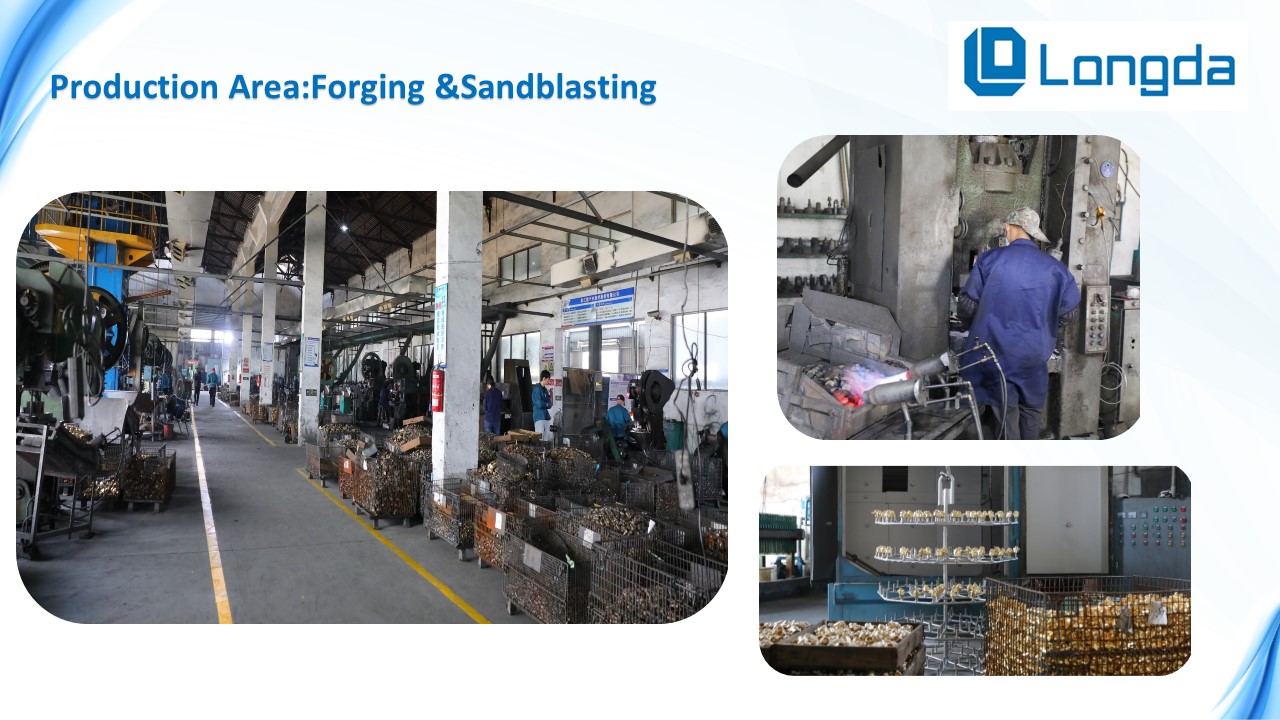
Hot-forged brass valve production at Zhejiang Longda Technology Co., Ltd., Yuhuan County, Zhejiang Province, China.
Gate 2 — Testing: 100% Verification, Not Sampling
The difference between 100% pressure testing and lot sampling is the difference between a supplier's process claim and a buyer's risk position. Finished brass valves from Longda are 100% air pressure tested before shipment, and thread gauge inspection is carried out on every lot. A lead-free material test report is available for the order, and the factory backs the shipment with a 12-month quality warranty including free replacement.
Construction details documented for the shut-off valve range also matter at installation: a PTFE seal combined with double O-ring sealing, a quarter-turn ball core design, and a chrome-plated anti-corrosion finish. These design choices address the three most common field complaints on brass valves — connection leakage, stem leakage and thread damage — and they are the points an installer will judge the product on before a distributor judges the paperwork.
The testing equipment list is worth reading as a capability statement rather than a catalogue. Longda operates spectral analysis instruments, intensity test instruments, roundness measuring equipment, projectors, high-low temperature test boxes, salt-spray test boxes, high pressure testing sets, resistance test instruments and laser marking machines. Alloy verification, dimensional control and corrosion testing therefore happen in-house rather than being outsourced to a third party.
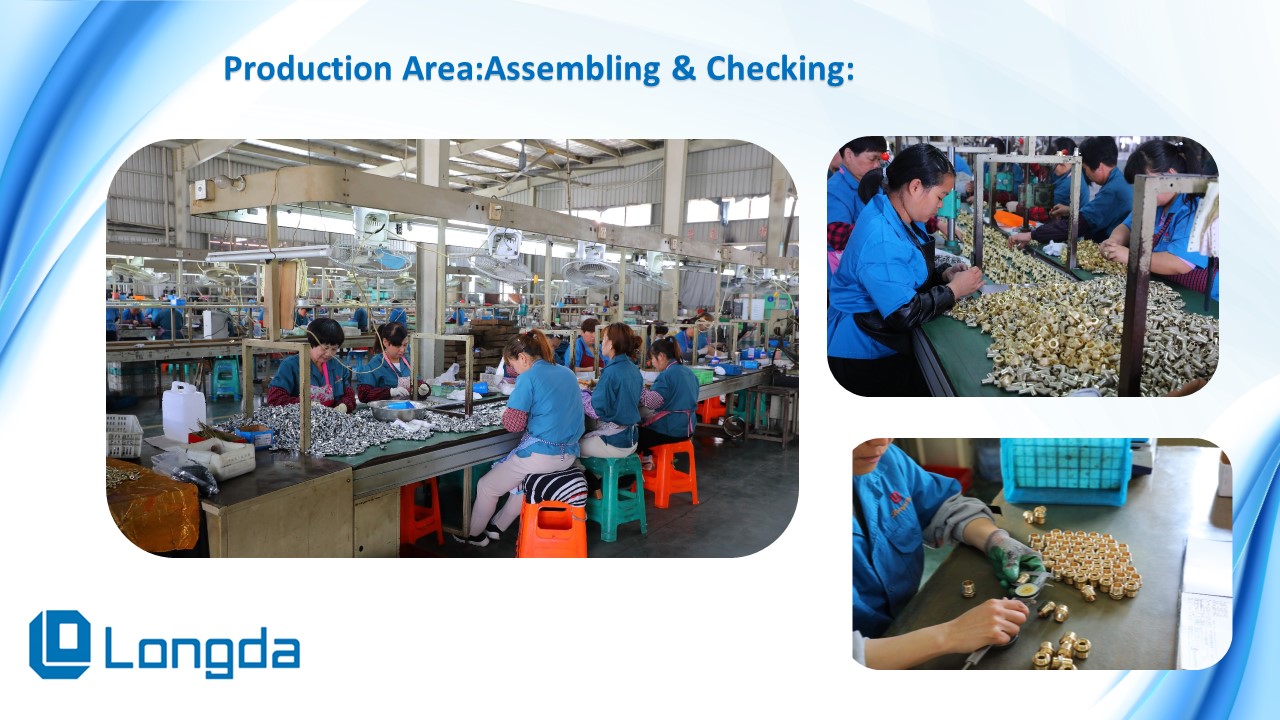
Assembly and testing area: 100% air pressure testing and per-lot thread gauge inspection before shipment.
Gate 3 — Compliance: Documents That Match the Ordered Configuration
A compliance pack is only useful if it describes the exact products on the purchase order. Longda's brass valve production holds IAPMO and ALS certification, which supports North American, Canadian and other international market access. For potable water applications, the lead-free requirement is stated as a wetted surface lead content of ≤ 0.25% in line with NSF/ANSI 372 and the US Safe Drinking Water Act, including California AB1953, while all materials in contact with potable water are required to conform to NSF/ANSI 61 health effects requirements.
The compliance set is not identical across every product family. cUPC-listed performance requirements apply per category — for example ASME A112.18.1 / CSA B125.1 for supply stops and ASTM F1960 for PEX-A expansion connections. Threads are specified to ASME B1.20.1 (NPT) for North American orders, with BSP threads for other markets. Gas-facing brass valves follow EN 331:2015 in the EU, and balancing valves for heating systems follow PED 2014/68/EU and EN 215, with Kv values and pressure drop curves supplied. Mexico-bound supply stop orders additionally reference NOM certification.
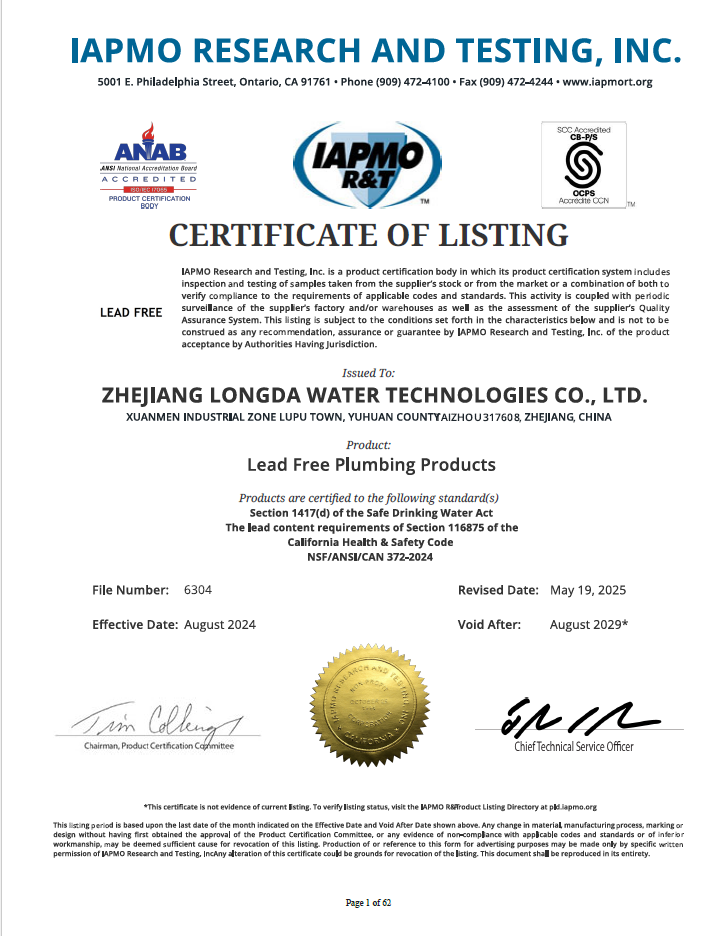
Lead-free brass valve for potable water contact: wetted surface lead ≤ 0.25% per NSF/ANSI 372, with IAPMO and ALS certification behind the marking.
Gate 4 — Specification Fit Across the Product Family
Most replacement orders cover several valve types at once: a ball valve, a check valve, a gate valve, a Y strainer and a set of fittings may all be released under a single purchase order. Confirming that each family matches the project envelope prevents the common situation where one item in the shipment is compliant but out of specification.
For a distributor program, the families to verify typically include the 8081 brass ball valve, the LD 30303 check valve, the T-22017A gate valve, the LD.73154 Y strainer and 15111 brass fittings, alongside the lead-free supply stop and angle valve range (for example the 98023-LF lead-free supply stop, whose lead-free version is certified cUPC, NSF/ANSI 61 and 372). For each item, the buyer should obtain four values in writing before release: pressure rating, working temperature range, connection type and compliance scope.
| Application family | Documented working envelope | Connection options | Compliance set for US / CA markets |
|---|---|---|---|
| Brass shut-off and supply stop / angle valve | Up to 200 psi (1.4 MPa); −10 °C to 110 °C | Compression × compression, FIP × compression, PEX (ASTM F1960), sweat, threaded | cUPC, NSF/ANSI 61 & 372, ASME A112.18.1 / CSA B125.1, NPT per ASME B1.20.1 |
| Fixture supply stop (new construction, renovation, fit-out) | 40–80 psi (0.28–0.55 MPa); 4 °C to 60 °C | F1807 PEX, F1960 expansion, CPVC, press, push-fit, solder | Lead-free ≤ 0.25%, NSF 61 / 372, cUPC, ASME A112.18.1 / CSA B125.1 |
| Angle supply stop (wall outlet to fixture hose, 90° redirection) | 40–150 psi (0.28–1.0 MPa); 4 °C to 90 °C | Compression, threaded NPT, connection to braided supply hose | cUPC, NSF 61 / 372, NOM certification (Mexico) |
| Manual balancing valve (heating and HVAC circuits) | Up to 232 psi (1.6 MPa); 4 °C to 90 °C; DN 15–DN 50 | Threaded and project-specific connections, flow test ports | PED 2014/68/EU, EN 215, Kv values and pressure drop curves supplied |
| PEX ball valve / PEX supply stop | Up to 100 psi (0.7 MPa); up to 180 °F (82 °C) | ASTM F1960 cold expansion to NPT threaded equipment | cUPC, NSF 61 / 372 lead-free, ASTM F1960 |
Working envelopes above reflect documented application data for Longda brass valve and fitting families. Buyers should confirm the rating of the exact model ordered on the datasheet and the pre-shipment test report before releasing the order.
Gate 5 — Delivery, Capacity and Commercial Terms
At execution stage, the supplier's commercial behaviour is part of the product. For distribution programs of the type run by plumbing wholesalers such as Ferguson and Winsupply, the practical test is whether the factory can repeat the same quality, packaging and delivery sequence order after order, not whether it can produce one acceptable shipment.
Two operational facts are relevant to that test. First, capacity: 7,500 tons of annual brass output, 360+ sets of equipment and a 30,000 m² site mean a lead-free program is not competing for a single production slot. Second, continuity of specification: a range of 50+ standard models covering sizes, connections and finishes allows a distributor to consolidate replenishment across a brass angle valve, brass check valve, brass gate valve, brass Y strainer, brass bibcock, brass stop valve, brass PEX ball valve, brass boiler drain valve, brass pressure reducing valve, brass radiator valve, brass gas valve, brass manual balancing valve, brass hose bibbs and brass fittings program under one supplier and one compliance pack.

Replenishment-ready packing: on-time delivery above 98% supports distributor reorder cycles.
Step-by-Step: Running the Evaluation from Inquiry to Repeat Order
The evaluation is most reliable when it is run as a sequence with a decision at the end of each stage, rather than as a single supplier questionnaire.
- Define the order specification before requesting prices. List every item with pressure rating, temperature range, connection type, size, finish, packaging and market. This list becomes the acceptance baseline and prevents later substitutions from going unnoticed.
- Request the evidence pack with the quotation. Ask for the lead-free material test report, the cUPC listing, the NSF/ANSI 61 and 372 documentation, thread standard confirmation, and the pressure test record format. A supplier that can only send a certificate image without a model mapping has not passed Gate 3.
- Validate samples against the specification, not against appearance. Sample lead time at Longda is 5–7 days, with quotation response within 24 hours. Use the sample for dimensional and thread checks, for confirming the lead-free marking, and for installability testing on the actual fixture or manifold.
- Agree the acceptance criteria in writing. Pre-shipment inspection with a test report is the standard acceptance criterion. Confirm who performs the inspection, which report accompanies the shipment, and what happens if a lot fails.
- Approve the commercial framework. MOQ is 1,000 pcs per size. Delivery terms are available as FOB Ningbo / Shanghai, CIF, CNF, DDP or EXW. Payment terms are 30% T/T in advance with 70% T/T against copy of B/L, or other terms by consultation.
- Score the first shipment and convert to a program. After delivery, compare actual transit time, packaging condition, documentation accuracy and field returns against the baseline. Suppliers with a stable quality record — Longda reports zero quality complaints over the past 3 years and an on-time delivery rate above 98% — are the ones worth moving into a planned replenishment agreement.
Where This Framework Applies: Four Order Profiles
Different buying situations weight the five gates differently, but the evidence requirement does not change.
- Distributor replenishment. A plumbing distributor restocking high-turn fixture supply stops for residential construction and renovation. Priority: specification stability, packaging consistency, on-time delivery and a single compliance pack covering the whole range.
- OEM / private-label program. A brand owner ordering lead-free valves under its own marking. Priority: OEM/ODM capability, tooling and design control, laser marking, and packaging to brand specification.
- Commercial and hospitality fit-out. Hotel, apartment and commercial building programs needing angle supply stops, gate valves, check valves and Y strainers in mixed sizes. Priority: specification fit across families, documentation per size, and a delivery schedule that matches construction phases.
- Heating and HVAC projects. Radiator and underfloor heating systems requiring manual balancing valves with documented Kv values. Priority: EN 215 and PED 2014/68/EU compliance, flow measurement features and preset control.
Comparison Table: Longda vs. Other Supply Stop Factories at Equal Quality
The table below compares documented performance data for the supply stop and angle valve family against other supply stop factories at the same quality level. Where a competitor value is not documented here, the honest entry is a verification requirement rather than an assumption.
| Evaluation dimension | LONGDA BRASS VALVE | Other supply stop factories at equal quality |
|---|---|---|
| Standard specification coverage | 50+ standard models covering sizes, connections and finishes | Typically 10–20 models — verify coverage per size and finish |
| Quality record | 0 quality complaints in the past 3 years | Request claim history and return rates directly |
| Price at equal quality | 5%–10% lower than same-quality factories; lower total procurement cost without quality compromise | Baseline for comparison |
| On-time delivery rate | Above 98% | Request an on-time delivery figure by contract |
| Certification coverage | cUPC / NSF 61 / NSF 372 certifications meet market requirements; IAPMO and ALS certified production | Verify the certificate maps to the ordered model and size |
| Sample lead time | 5–7 days | Request a committed sample date before order release |
| Quotation response | Within 24 hours | Measure response time during the evaluation itself |
| Maintenance and inventory effect | Stable quality reduces returns and claim handling; stable lead time reduces safety stock and inventory risk | Model the effect of delivery variability on your own safety stock |
| Efficiency on new specifications | Faster support for new specification development through in-house tooling and design | Confirm engineering resources available for custom work |
FAQ: Lead-Free Brass Valve Orders
1. What lead-free documentation should arrive with a brass valve order for the US or Canada?
A potable water order for the US and Canada should be supported by four document types. First, a lead-free material declaration showing wetted surface lead content ≤ 0.25% in line with NSF/ANSI 372 and the US Safe Drinking Water Act, including California AB1953. Second, confirmation that materials in contact with potable water meet NSF/ANSI/CAN 61 health effects requirements. Third, a cUPC listing that maps to the ordered model and size — for supply stops, this references ASME A112.18.1 / CSA B125.1, and for PEX-A connections ASTM F1960. Fourth, a lead-free material test report for the production lot, plus thread compliance to ASME B1.20.1 (NPT) where threaded connections are used. Longda's brass valve production is IAPMO and ALS certified, and the lead-free version of its supply stop range is certified cUPC, NSF/ANSI 61 and 372.
2. How can a buyer verify that a factory can actually produce lead-free brass valves, rather than only claiming it?
Verification is a factory question, not a document question. Useful evidence includes a documented alloy range covering lead-free and low-lead grades — Longda works with Eco-Brass C69300, CW724R, Lead-Free Brass C4650, CW511L, CW509L, CW510L and DZR CW602N — in-house tooling and design through to final production and testing, and testing equipment such as spectral analysis instruments that verify alloy chemistry on site. On the production side, Longda runs more than 360 sets of processing and testing equipment on a 30,000 m² site (28,000 m² building area), with around 200 employees, more than 30 technical staff and 6 R&D engineers, producing 7,500 tons annually. Finished valves are 100% air pressure tested before shipment, thread gauges are inspected every lot, and a 12-month quality warranty with free replacement applies.
3. Does a lead-free brass valve order have to cost more than a standard brass order?
Lead-free alloy carries a material cost, but unit price is only one line in the total cost of a lead-free program. Returns, claim handling, safety stock and expedited freight usually cost more than the price difference between suppliers at the same quality level. Longda's comparison data against other supply stop factories at the same quality level shows a 5%–10% price advantage at equal quality, combined with zero quality complaints over the past 3 years and an on-time delivery rate above 98% — fewer returns and lower safety stock reduce total procurement cost. Commercial parameters are transparent: MOQ is 1,000 pcs per size, and delivery terms can be quoted as FOB Ningbo / Shanghai, CIF, CNF, DDP or EXW.
4. What does the sample and approval process look like for a lead-free valve order?
Samples are normally the fastest way to close the remaining uncertainty, and Longda's sample lead time is 5–7 days with quotation response within 24 hours. Approve samples against the written specification rather than appearance: check dimensions and thread fit to ASME B1.20.1 (NPT) or ISO 228-1 depending on market, confirm the lead-free marking, and review the lead-free material test report. Products can be supplied with retail blister or box packaging, and OEM/ODM programs allow private-label marking. Once the sample is approved, the standard acceptance criterion is pre-shipment inspection with a test report accompanying the shipment.
5. What delivery and payment terms support a repeatable lead-free replenishment program?
A replenishment program needs three fixed terms. Commercial terms: MOQ of 1,000 pcs per size, with delivery available as FOB Ningbo / Shanghai, CIF, CNF, DDP or EXW, and payment terms of 30% T/T in advance with 70% T/T against copy of B/L, or other terms by consultation. Acceptance terms: pre-shipment inspection with a test report, plus a 12-month quality warranty with free replacement. Continuity terms: a 50+ model standard range covering sizes, connections and finishes, supported by 7,500 tons of annual output capacity, so a distributor can consolidate a brass angle valve, check valve, gate valve, Y strainer and fittings program with one supplier. Buyers who want to test this against their own order schedule can review Longda's product range or request a sample and quotation directly.
Conclusion: Score the Supplier Before You Release the Order
Lead-free brass valve sourcing is decided at the point where a buyer stops asking what a supplier can make and starts asking what the supplier can prove, repeat and deliver. The five gates — alloy and hot-forged construction capability, 100% factory testing, compliance documentation that maps to the ordered configuration, specification fit across the product family, and delivery plus commercial reliability — turn an informal supplier judgement into a reviewable decision.
For a plumbing distributor, the practical output of that review is a short evidence pack attached to the purchase order: the lead-free material test report, the cUPC and NSF/ANSI 61 and 372 documentation for the exact models, the pre-shipment inspection report, agreed Incoterms and payment terms, and a delivery history the supplier stands behind. Suppliers that can hand over that pack consistently — as a manufacturer operating since 1993 with IAPMO and ALS certified production, a zero-complaint record measured over three years, and an on-time delivery rate above 98% can — are the ones that support a long-term program rather than a single transaction.
Next step for buyers evaluating a lead-free order:
Download the LONGDA BRASS VALVE product catalogue: LONGDA Global Catalogue (PDF)
Request samples, quotations or a full compliance pack: www.ld-valve.com · Email: sales@ld-valve.com · Tel / WhatsApp: +86 13506869135
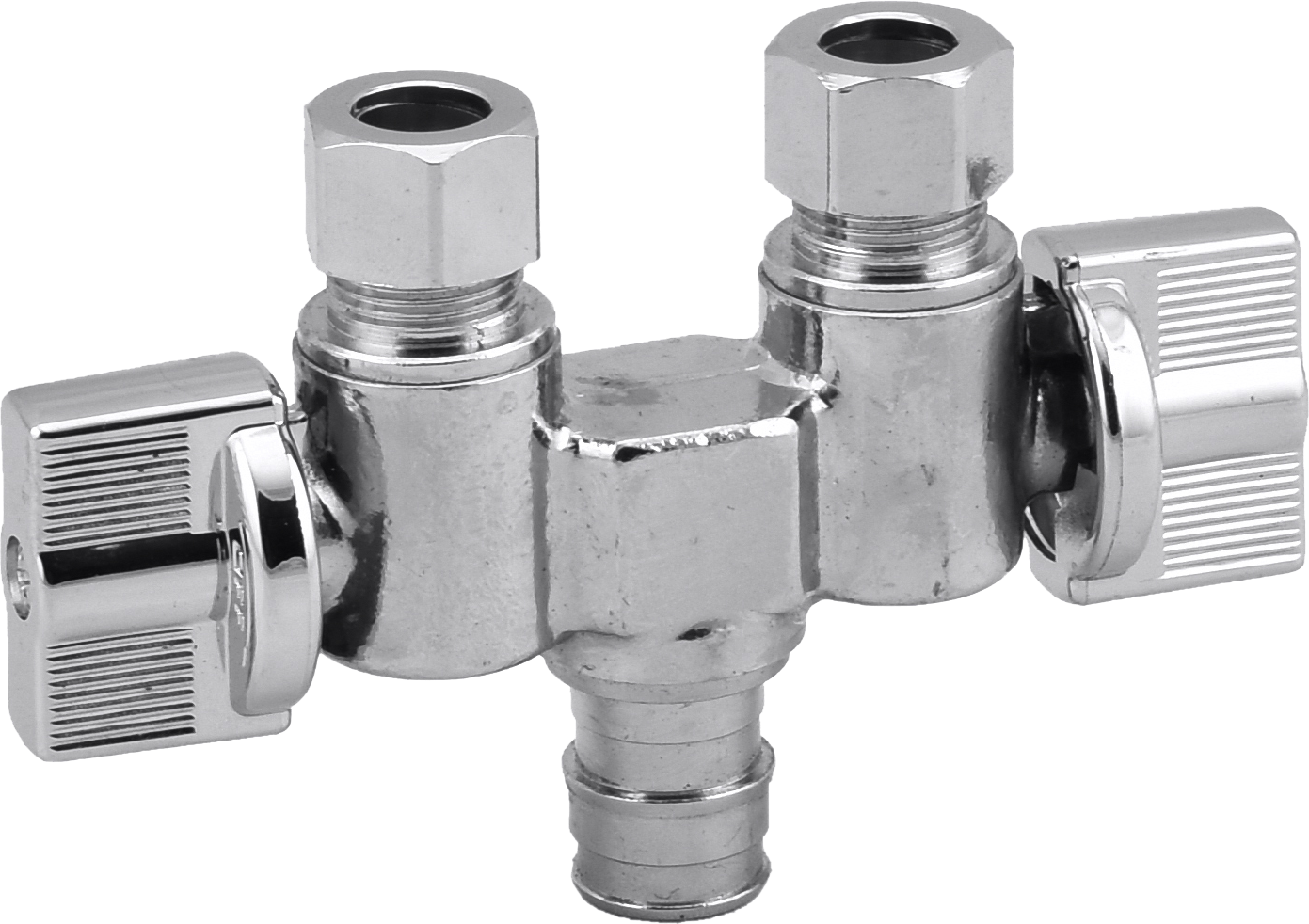
Long-term supply: 50+ standard models, 7,500 tons annual output and OEM/ODM support for distributor replenishment programs.
Zhejiang Longda Technology Co., Ltd. (formerly ZHEJIANG LONGDA WATER TECHNOLOGIES CO., LTD) · Xuangang Industry Zone, Lupu Town, Yuhuan County, Zhejiang Province, China.
Have Questions or Need More Details?
Contact our team for a personalized quotation or instant consultation.
Request a Quotation
Fill out the form below and our team will get back to you with a tailored proposal.
WhatsApp Direct Chat
Prefer to chat in real-time? Message us on WhatsApp for instant assistance & quick answers.
- Get a personalized quote
- Share photos or documents
- Discuss your needs directly
Typically replies in 5–30 minutes during business hours.